
Subiaco Primary School was established in 1897.
The following information offers glimpses of Subiaco Primary School in its early days.
At the opening of the Subiaco School in 1897, a representative of the District Board of Education had remarked upon the swiftness of Subiaco’s transformation, pointing out that it had only recently been notable more for wildflowers than people, but that there was now a need to cultivate the ‘much more precious flowers’ of its youth.
By the turn of the century, Subiaco School had been divided into a ‘Senior School’ and an ‘Infants School’, with the latter housed in a new building adjacent to the perpetually crowded older school on Bagot Road. It soon also became necessary to establish an ‘Intermediate School’, situated on the Hamersley Road side of the central block. For several years, the Subiaco Infants School was one of only two such schools in the metropolitan area.
From letters on attendance, it is clear that the School quickly became overcrowded. The 1904 letter shows that some children had moved to Thomas Street School, which opened that year. Education Department files show that in 1912 the Senior School roll was 603 students and 423 Infants. Pending additions to the Senior School, the school rented a room from the Church of Christ.
Excerpts from Spillman K, 1985, Identity Prized A History of Subiaco; 1979, Seeds of Subiaco; Subiaco WA, University of Western Australia Press, City of Subiaco, Subiaco.


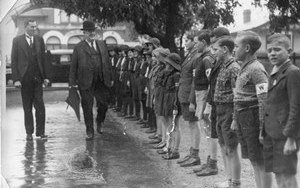
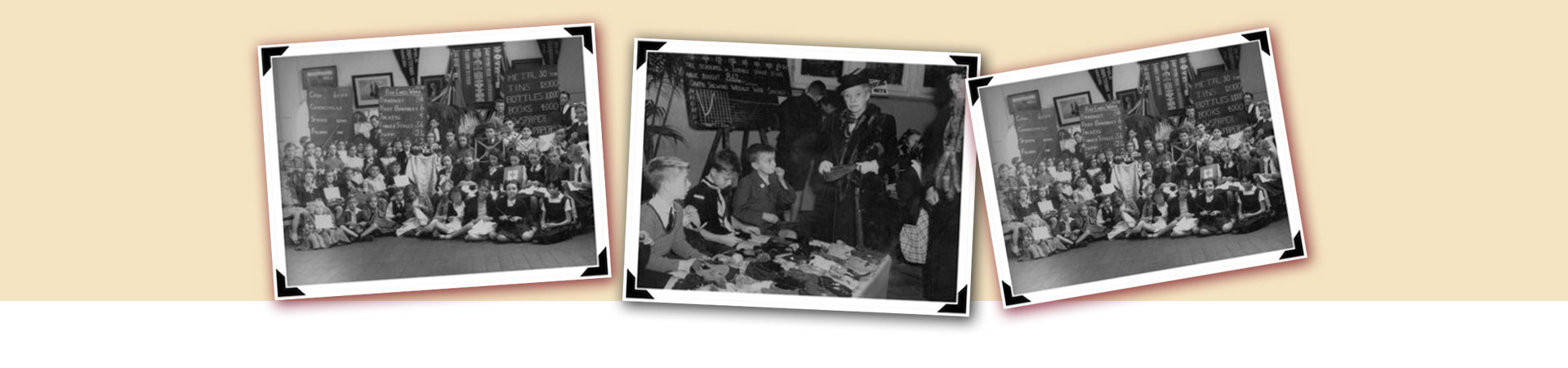
These two photos were taken on July 2, 1942, when Lieutenant Governor Sir James Mitchell visited the school to see how students and local scouting groups were doing their bit for the war effort. The school’s kazoo band played the national anthem before the delegation of VIPs was served food cooked by students from the domestic science centre. They were also shown approximately 50,000 metal bottle tops, two tonnes of scrap rubber – including truck tyres and baby’s dummies – and clothes collected to help clothe Londoners. The children had made camouflage nets, sand mats, ropes, and knitted hot water bottle covers. The school also held first-aid demonstrations and had more than 800 war savings certificates.
“Sir James Mitchell expressed himself as being highly gratified with all that he had seen,” The West Australian Reported on July 9, 1942. ” On leaving, Sir James said that the pupils’ efforts were an example to be emulated by all in the community”.
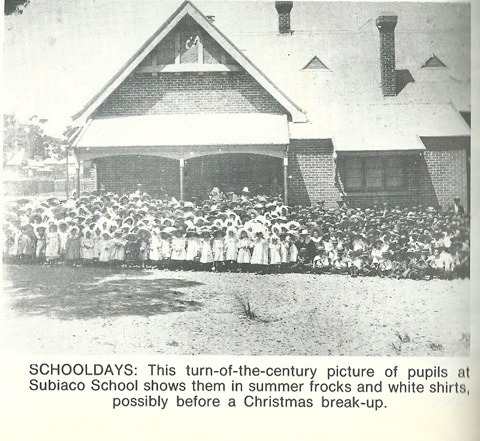
This photo of Subiaco School shows the children in their summer frocks and white shirts, possibly before a Christmas break.
SUBIACO SCHOOL PRINCIPALS
1896-1899 – Syd. J. Grace
1900-1903 – James Klein
1904-1906 – Henry Wheeler
1907-1911 – James Miles
1912-1916 – William Shelton
1917-1918 – Horace Thomas
1919-1920 – Thomas Harper
1920-1933 – Robert Llewellyn
1934-1936 – Victor White
1937-1943 – Alan Morrison
1943-1945 – Marcus Anderson
1946-1948 – Robert Johnston
1948-1953 – Cecil Kershaw
1954-1959 – William Pirrett
1960-1966 – Albert Williams
1967-1973 – Stan Hughes
1973-1974 – Ken Griffith
1975-1978 – John Wray
1978-1978 – K.Leggett
1979-1981 – Howard Milne
SUBIACO SCHOOL PRINCIPALS (CONT)
1982-1984 – Bevan John Hadlow
1985-1990 – Richard Francis Anthony
1991-1993 – David John Bryant
1994-1998 – Roderick Eagleton
1999-2006 – Ken Perris
2007-2008 – Susan Goddard
2009-2010 – Ken Perris
2010-2020 – Carolyn Press
2021-2021 – Bea Bouska
2022-2024 – Melinda Harris
2024 – Heather McNeil
INFANT SCHOOL HEADMISTRESSES
1900-1902 – Elizabeth Julius
1903-1904 – Jessie Birch
1906-1930 – Mary Hislop
1931-1933 – Irma Lutz
1934-1936 – Doris Marsden
1937-1948 – Elizabeth Glendinning
1949-1953 – Flora Tait
1954-1956 – Janet Lindsay
In 1922, the first Parents and Citizens Association (P&C) was formed, with Mr Ophie becoming the first President.
From 1956, the Infant School buildings were no longer used as a school, and the Senior School became Subiaco Primary School.
In 2013, a natural playground was built among the 100-year-old Moreton Bay Fig trees. It is now a magnificent area for students to engage in creative and imaginative play whilst interacting with nature.
In 2014, our Library was completely refurbished and is now a colourful and engaging space for our students to enjoy.
In 2017, a four-cluster classroom ECE block and new tennis courts were completed for the start of the 2018 school year.
In 2017 and 2018, two natural and engaging playgrounds were built in the Kindergarten and Year 1 areas.
Currently, many of the classrooms are housed in the original buildings. The school has a Library, Music, Art, STEAM, French and Science room and a Learning Support Room. On-site facilities include a large undercover assembly area, tennis/basketball courts and a six-lane, 17-metre swimming pool.
Please let us know if you have any other photos to share with us!